Welcome to the website for landscape facilities products and knowledge.

How do we prevent people from dumping household trash in public space trashcans?
We’ve all seen it: a public trashcan in a park or on a street corner overflowing with bulging black bags, pizza boxes, and old clothes—clearly not the litter from a single passerby, but someone’s entire household waste. These cans are meant for the apple core, the coffee cup, the receipt from your pocket. When they become free dumping zones, they smell, attract pests, and defeat their purpose. So how do we prevent this without turning every garbage bin into a fortress? Here’s my take, spoken from the street-level perspective of the “cans” themselves.
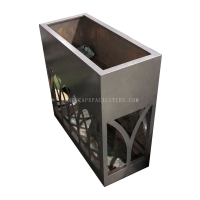
First, let’s change the container’s personality. If I were a public trashcan, I’d ask for a smaller opening. The classic round top with a swinging lid is a welcome mat for bulky bags. But if my mouth is just a slit or a slot—like a mailbox—it becomes physically annoying to shove a 30-liter bag inside. Many cities now use “litter bins” with narrow, spring-loaded flaps that accept only hand-held waste. Simple design tweaks make dumping a chore.
Second, I need a clear identity. People dump because it’s easy and anonymous. I’d wear a bold, visible sign: “For public, on-the-go litter only. No household trash—fines apply.” The sign should list the penalty amount. In New York, leaving household trash next to a public bin can cost up to $400. Just the scary number stares back at anyone who hesitates.
Third, I’d rely on my human friends—the surveillance neighbors. If you place bins near shopfronts or homes with windows, the “eyes on the street” effect kicks in. My best location is not a hidden alley but a spot visible from a coffee shop window. A simple neighborhood watch sticker adds pressure: “This can is monitored by concerned citizens.” Social shame works better than locks.
Fourth, empty me more often. When I’m already full, I look like a legitimate place to start a pile. In Japan, public cans are rare, but where they exist, they’re emptied twice a day. A schedule posted on my side (“Emptied at 10 AM & 6 PM”) tells dumpers that their bag won’t sit there unnoticed for days. Quick turnover discourages accumulation.
Fifth, offer an alternative. The real reason people dump is lack of convenient curbside service, or a fee they want to avoid. If a block lacks affordable bulky waste pickup, public bins become substitutes. Cities can provide “free dumping days” or share a pick-up hotline on my sign. Sometimes giving a legal route stops the illegal shortcut.
Finally, I as a can can teach. With a QR code printed on my side—leading to a local waste disposal map—I make it easy for a tired parent or contractor to find the nearest transfer station. Knowledge defeats laziness.
So prevent dumping by making me inconvenient for bags, visible to witnesses, emptied on schedule, and paired with a better option. I’m not just a can—I’m a tool for community sanity. Treat me right, and I’ll serve your streets without being abused.
Related search: