Welcome to the website for landscape facilities products and knowledge.

Can you show me some examples of how you've integrated a trashcan into a landscape facility design so it's not an eyesore?
Ah, the humble trash can. Often treated as a necessary evil in public spaces, it doesn't have to be a visual blight. As a designer, I see every element as part of a cohesive story. The waste receptacle is no exception. Let me share some ways I've woven this functional piece into the landscape narrative, making it not just accepted, but appreciated.
First, I believe in strategic camouflage. Instead of a standalone plastic bin, I specify receptacles built into other structures. Imagine a robust, beautifully crafted park bench where one armrest lifts to reveal a discreet waste opening. The bin is accessed from the side for maintenance, but to the visitor, it's simply part of the seating. Another favorite is the "hollow log" – a receptacle crafted from durable, textured materials that mimic fallen timber, nestled naturally among real trees and planting beds.
Second, material harmony is key. In a sleek, urban plaza, I've used stainless steel bins that reflect the surrounding glass and steel architecture, their geometric shapes echoing nearby sculptures. For a historic garden, I've designed custom enclosures using the same local stone as the retaining walls or pathways. The bin becomes a subtle, textured feature rather than an intrusion.
Third, consider the power of the perimeter. Placing bins at natural transition points—where a path meets a lawn, at the entrance to a wooded trail, or beside a water fountain—makes them feel intentional. Here, they are part of the "furniture" of decision-making, used as people naturally pause or change direction. I often pair them with a vertical element like a signage post or a small trellis to create a cohesive utility station.
Finally, embrace multifunctionality. A low planter box with a central, grated section for waste allows greenery to soften the hard purpose. A series of bollards with integrated, narrow slot openings for litter can line a path, providing rhythm and order while handling small waste like wrappers.
The goal is never to hide the bin so well it can't be found, but to integrate it with such thoughtful design that it contributes to the sense of place. When a trash can feels like a considered part of the landscape, people are more likely to use it respectfully, completing a virtuous cycle of good design and conscientious use.
Related search:
Recommendation
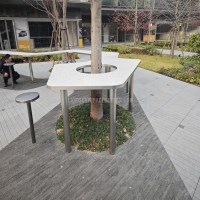
An outdoor bar counter with stainless steel and terrazzo materials in an irregular shape






