Welcome to the website for landscape facilities products and knowledge.

How does the table’s design account for thermal comfort in hot or cold weather conditions?
In the realm of outdoor furniture, a table's design plays a pivotal role in ensuring thermal comfort and usability across scorching summers and freezing winters. The core principle lies in material science and intelligent engineering. For hot climates, designers select materials with high thermal emissivity and low heat capacity, such as certain treated woods, specialized composites, or light-colored, porous stones. These materials absorb less solar radiation and dissipate heat quickly, preventing the surface from becoming unbearably hot to the touch. Innovative designs incorporate ventilated substructures or integrated shading elements to promote air circulation and reduce direct sun exposure on the primary contact surface.
Conversely, for cold weather resilience, the focus shifts to thermal insulation and conductivity management. Tables designed for chilly environments often utilize materials with low thermal conductivity, like thick, sealed hardwoods or insulated synthetic tops. These materials act as a barrier, slowing the transfer of cold from the ambient air to the table's surface, making it more comfortable to rest arms or place items upon. Furthermore, the structural design accounts for thermal expansion and contraction. Engineers employ expansion joints, flexible fasteners, and stable alloy frames to prevent warping, cracking, or joint failure as materials naturally expand in heat and contract in cold.
Beyond the tabletop, the holistic design considers the entire user experience. Coatings with infrared-reflective pigments can significantly reduce surface temperature in the sun. In integrated heating solutions, some high-end designs incorporate radiant heating elements within the table frame for use in perpetually cool settings. The strategic use of textures—slightly roughened finishes in hot climates to minimize skin contact area, and smoother, sealed surfaces in cold ones to avoid moisture retention—further enhances tactile comfort. Ultimately, a thermally conscious table design is a symphony of selected materials, proactive engineering for dimensional stability, and user-centric features that collectively ensure the furniture remains a comfortable, durable, and inviting centerpiece in any outdoor space, regardless of the thermometer's reading.
Related search:
Recommendation
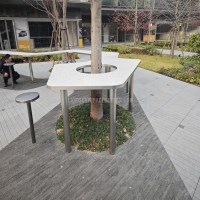
An outdoor bar counter with stainless steel and terrazzo materials in an irregular shape






