Welcome to the website for landscape facilities products and knowledge.

How does the manufacturer ensure the table’s resistance to damage from chemical spills or stains?
Manufacturers ensure a table's resistance to chemical damage through a multi-faceted engineering approach, beginning with the core material selection. High-pressure laminates, solid phenolic resins, epoxy resins, and stainless steel are chosen for their inherent inertness and non-porous structures, which prevent liquids from penetrating the surface. The cornerstone of defense is the application of advanced, catalyzed finish systems. These are not simple paints but chemically cured coatings—such as polyurethane, polyester, or epoxy-based finishes—that form an impermeable, continuous barrier. This barrier actively repels a wide range of acids, bases, solvents, and common staining agents.
The process involves rigorous surface preparation and precise, controlled application, often in multiple layers, to eliminate weak points. Performance is validated through standardized chemical resistance tests, where samples are exposed to specific reagents for extended periods and then evaluated for discoloration, swelling, or gloss loss. Compliance with standards like ANSI/BIFMA or specific chemical resistance ratings provides objective proof of durability. Furthermore, the integration of seamless edges, coved backsplashes, and tight seam sealing ensures there are no entry points for corrosive fluids. Ultimately, it is the synergy of inert substrate, sophisticated coating chemistry, and seamless construction that creates a tabletop capable of withstanding harsh environments, maintaining its integrity and appearance over years of demanding use.
Related search:
Recommendation
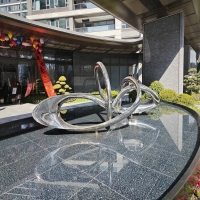
Abstract art sculpture, stainless steel metal sculpture, large-scale water feature sculpture






