Welcome to the website for landscape facilities products and knowledge.

How does the manufacturer address potential issues like cracking from freeze-thaw cycles?
Manufacturers employ a multi-faceted engineering approach to address the destructive potential of freeze-thaw cycles, a primary cause of cracking in porous materials like concrete. The core strategy involves designing materials with inherent resistance. This is achieved by using specialized chemical admixtures, such as air-entraining agents, which create microscopic, non-connected air bubbles within the material matrix. These bubbles act as pressure relief valves, allowing expanding frozen water to compress the air pockets rather than generating destructive internal stress that leads to cracking.
Beyond formulation, rigorous testing protocols are fundamental. Manufacturers subject material samples to accelerated laboratory freeze-thaw cycling, often following standards like ASTM C666, to empirically validate performance before market release. Quality control during production ensures consistent air-void system parameters and proper consolidation to eliminate flaws that become failure points.
Furthermore, advanced manufacturers integrate supplementary cementitious materials (SCMs) like fly ash or slag, which refine pore structure and reduce permeability, thereby limiting water ingress in the first place. The application of hydrophobic sealers or crystalline waterproofing technologies at the production or installation stage provides an additional defensive barrier. Ultimately, addressing freeze-thaw damage is a proactive process rooted in material science innovation, precise manufacturing, and continuous performance verification, ensuring long-term structural integrity and reducing maintenance liabilities for end-users.
Related search:
Recommendation
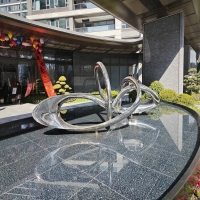
Abstract art sculpture, stainless steel metal sculpture, large-scale water feature sculpture






