Welcome to the website for landscape facilities products and knowledge.

How does the table’s design support the creation of collaborative or interactive outdoor environments?
The humble outdoor table is undergoing a transformative redesign, evolving from a static piece of furniture into a dynamic catalyst for community interaction. Modern design principles are intentionally shaping these tables to become the heart of collaborative and interactive outdoor environments. This is achieved through several key design strategies that prioritize human connection and engagement.
Firstly, modularity and flexibility are paramount. Tables with detachable sections, adjustable heights, or movable units allow spaces to be reconfigured spontaneously. A long communal bench can break apart into smaller clusters for intimate group work, then reassemble for a larger community meal. This adaptability empowers users to define their own interactive experience, fostering a sense of ownership and spontaneity in the public realm.
Secondly, integrated technology and interactive surfaces are becoming central. Designs now incorporate built-in power outlets, USB ports, and wireless charging pads, removing the barrier of dwindling device batteries and encouraging longer stays. Some tables feature dry-erase or magnetized surfaces, turning the tabletop itself into a canvas for brainstorming, gaming, or casual artistry. This transforms passive seating into an active, participatory platform.
Material and form also play a crucial psychological role. Durable, high-quality materials like weathered steel, smooth concrete, or warm hardwood signal permanence and care, inviting people to linger. Organic shapes that eschew sharp corners promote circular, face-to-face seating arrangements, naturally facilitating eye contact and conversation. The incorporation of planter boxes or central greenery can soften the space and provide a shared point of interest.
Furthermore, the strategic placement and scaling of tables dictate social dynamics. Positioning tables along pedestrian flow encourages impromptu encounters, while slightly elevating a table on a platform can define a semi-contained gathering space without creating walls. Combining tables of varying heights—some for dining, others for standing with a coffee—caters to different interaction styles and durations, creating a layered, inclusive environment.
Ultimately, a well-designed outdoor table acts as social infrastructure. It is not merely a surface but an invitation—a designated spot that lowers the threshold for strangers to become collaborators, for ideas to be exchanged, and for community bonds to strengthen. By prioritizing flexibility, integration, and human-centric design, these tables move beyond function to actively script the possibilities of connection in our shared outdoor spaces.
Related search:
Recommendation
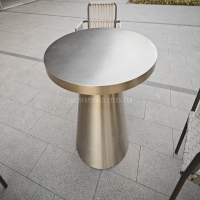
Outdoor Metal Table - Classic Outdoor Furniture, Stainless Steel Table, Durable and Reliable






