Welcome to the website for landscape facilities products and knowledge.

How does the table’s surface handle prolonged exposure to wet or damp conditions?
The durability of a table surface under prolonged wet conditions depends primarily on its material composition and protective treatments. Natural wood surfaces, while aesthetically pleasing, generally perform poorly when consistently exposed to moisture. Untreated solid wood can warp, swell, or develop mold within days of continuous dampness. However, sealed wood with multiple layers of polyurethane or marine-grade varnish can resist water penetration for extended periods, though eventual degradation occurs at seams or scratches.
Engineered materials demonstrate superior performance. Laminate tables with moisture-resistant cores and sealed edges can withstand damp environments for months without significant damage. Solid surface materials like quartz composites are virtually impervious to water, making them ideal for perpetually moist areas. Metal tables, particularly those with powder-coated or galvanized finishes, offer excellent resistance but may develop corrosion at joints over years of exposure.
The critical factor is surface integrity. Any breach in protective coatings—whether scratches on sealed wood or chips in laminate edges—creates pathways for moisture infiltration. Regular maintenance, including immediate drying and periodic resealing of vulnerable materials, dramatically extends a table's lifespan in damp conditions. For permanent wet environments, choosing inherently waterproof materials like stainless steel, treated concrete, or high-pressure laminate proves most effective, as these materials resist not just surface moisture but also the humidity that accelerates deterioration in porous surfaces.
Related search:
Recommendation
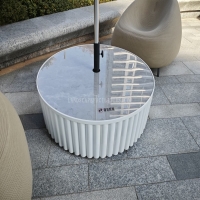
Round metal tube border design table with tempered glass or granite countertop on the top.






