Welcome to the website for landscape facilities products and knowledge.

How deep should a planter box be for growing small shrubs?
Hello, dear gardener! I am your planter box, and I have a simple request: please don't squeeze my inhabitants. When it comes to hosting small shrubs, my depth is not a trivial detail—it's the foundation of their future. So, how deep should I be to make them truly happy?
Think of me as a miniature landscape. While a small shrub's top may be modest, its roots dream of exploration. A depth of 18 to 24 inches (45 to 60 cm) is generally my sweet spot for most small shrubs. This provides a critical reservoir for moisture, nutrients, and space for roots to anchor securely against the wind.
But I must whisper a secret: my depth is more than just a number. First, consider the shrub's mature root ball. I should be at least 6 to 12 inches deeper and wider than this ball. A dwarf hydrangea will be content with 18 inches, while a robust dwarf holly might yearn for a full 24.
My second duty is impeccable drainage. Without proper holes at my base and a layer of gravel, I become a swamp, and roots will drown. Depth without drainage is a prison. Third, the soil you fill me with matters. A lightweight, well-draining potting mix feels like a luxury suite compared to heavy, compacted earth.
Finally, remember my material. I, a wooden or thick plastic box, insulate roots better than a thin metal pot. In colder climates, extra depth provides a buffer against freezing temperatures.
In essence, granting me generous depth is a promise of stability, hydration, and room to grow. It’s the difference between a shrub merely surviving and one flourishing vibrantly for years to come. So, when you choose me, think deep. Your shrubs will thank you with every lush, green leaf.
Related search:
Recommendation
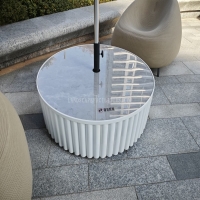
Round metal tube border design table with tempered glass or granite countertop on the top.






