Welcome to the website for landscape facilities products and knowledge.

What are the most significant differences in the table’s appeal to residential versus hospitality buyers?
The appeal of a table varies dramatically between residential and hospitality buyers, driven by fundamentally different core objectives. For the residential buyer, the table is a centerpiece of personal life. Selection prioritizes aesthetic harmony with the home's decor, emotional connection, and versatility for daily family use and occasional entertaining. Durability is often considered in terms of resisting family life, but long-term sentimental value can outweigh purely commercial-grade toughness. Budgets are typically fixed, and the purchase is a personal investment.
Conversely, the hospitality buyer approaches a table as a business asset. The paramount considerations are commercial durability, ease of maintenance, and operational efficiency. Tables must withstand constant use, frequent cleaning, and potential abuse. Space optimization and seat turnover are critical; dimensions and shapes are chosen to maximize covers without compromising guest comfort. While aesthetics are important for creating ambiance, they serve the brand's commercial identity. The cost is evaluated through a lens of total cost of ownership (ROI, longevity, repair costs) rather than personal taste alone.
The most significant differences lie in these priorities: the home seeks a personal statement, while hospitality requires a functional workhorse. A residential buyer might choose a delicate wooden table for its warmth, whereas a hotel restaurant would select a high-performance laminate for its resilience. Understanding this dichotomy is essential for designers, manufacturers, and sellers catering to these distinct markets.
Related search:
Recommendation
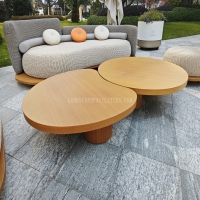
Elliptical metal outdoor table with nested design, resembling wood grain, round table






