Welcome to the website for landscape facilities products and knowledge.

How does the table’s design facilitate the use of embedded technology for interactive experiences?
Modern interactive tables transcend traditional furniture by integrating embedded technology directly into their structural design. The seamless incorporation of capacitive or infrared touch surfaces creates intuitive multi-user interfaces, while embedded projectors or LED matrices transform tabletops into dynamic visual canvases. Strategic sensor placement—including pressure sensors, motion detectors, and RFID readers—enables the table to respond to physical objects, gestures, and user presence without external peripherals.
The design prioritizes invisible technology integration, with carefully engineered compartments housing processing units, cooling systems, and connectivity modules within slim profiles. This allows the surface to remain unobstructed while supporting real-time data processing for collaborative applications. Angled bezels and anti-glare surfaces enhance visibility for shared viewing, while modular component design facilitates hardware upgrades.
Such tables utilize distributed computing architecture where edge devices process inputs locally before syncing with cloud systems, minimizing latency during collaborative tasks. The physical design also accommodates ergonomic considerations, with adjustable heights and rounded edges complementing the digital experience. These design choices collectively transform static surfaces into responsive environments for education, corporate strategy sessions, and immersive entertainment—proving that thoughtful physical design is crucial for unlocking embedded technology's full interactive potential.
Related search:
Recommendation
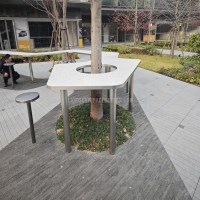
An outdoor bar counter with stainless steel and terrazzo materials in an irregular shape






