Welcome to the website for landscape facilities products and knowledge.

How does the table’s design accommodate the use of non-standard shapes or cutouts for creative layouts?
Modern table design has evolved beyond rectangular tops and standard legs, actively accommodating non-standard shapes and cutouts to serve creative layouts. This accommodation is fundamentally rooted in advanced digital fabrication and a design philosophy that prioritizes user-specific function and artistic expression.
The process begins with sophisticated CAD (Computer-Aided Design) software, which allows designers to model intricate organic forms, geometric patterns, or functional cutouts with precision. These digital blueprints are then executed using CNC (Computer Numerical Control) machining for rigid materials like wood, metal, or acrylic. CNC routers can flawlessly cut complex peripheries and internal cutouts, enabling shapes ranging from flowing, amoeba-like forms to tables with precise hexagonal voids. For softer curves or highly unique shapes, techniques like steam-bending for wood or advanced mold-making for composites and resins come into play.
The accommodation of these features is deeply intentional. A serpentine table edge might define conversational zones within an open-plan space, while a strategic crescent-shaped cutout can allow for closer seating or integrate a planter. Designers must carefully engineer structural integrity, often using reinforced substrates, strategic leg placement, or integrated support frames hidden beneath the top to compensate for material removed by cutouts. The choice of material is paramount; for instance, a sturdy live-edge slab can handle a natural void, whereas a glass top with a cutout requires tempered edges and precise support.
Ultimately, this design approach transforms the table from a mere surface into a spatial orchestrator. It allows the furniture to adapt to architectural quirks, enhance user interaction, and serve as a standalone sculptural element. By embracing non-conformity in shape, designers create tables that are not just used but experienced, fostering unique and personalized environments.
Related search:
Recommendation
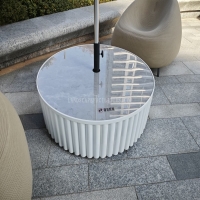
Round metal tube border design table with tempered glass or granite countertop on the top.






