Welcome to the website for landscape facilities products and knowledge.

How does the table’s design impact the ease of personalization for individual users?
The design of a table fundamentally dictates how easily and effectively it can be personalized to suit an individual user's needs. A well-considered design transforms a static piece of furniture into a dynamic tool that adapts to preferences in comfort, workflow, and aesthetics.
At its core, personalization is about control. Table designs that incorporate modular elements offer the highest degree of this control. Features like interchangeable panels, add-on shelving units, integrated cable management systems, and configurable layouts allow users to physically reconfigure their workspace. This modularity enables the table to evolve alongside changing projects, technologies, or personal organizational styles, making the personalization process intuitive and tool-free.
Material and construction choices are equally pivotal. Surfaces that are durable yet receptive to customization—such as those suitable for applying decals, writing directly on, or attaching accessories with magnets or adhesive—invite user expression. The physical form factor, including the presence of rounded corners, varied thickness, and the inclusion of built-in power outlets or device docks, can either constrain or liberate how a user interacts with and claims the space as their own.
Ergonomics, a critical component of design, directly impacts personalized comfort. Tables with easily adjustable height mechanisms, whether manual or electronic, empower users to tailor their setup for seated or standing use, promoting long-term health and comfort. The ease of making these adjustments—often with a simple button press or crank—determines how frequently and willingly a user will engage in personalization. A design that makes ergonomic tailoring difficult discourages it altogether.
Ultimately, a table designed with personalization in mind anticipates diversity. It moves beyond a one-size-fits-all approach to provide a flexible framework. The most successful designs are those that recede into the background, offering a stable and adaptable foundation upon which the individual user can imprint their unique identity, work habits, and comfort requirements, thereby enhancing productivity, satisfaction, and a sense of ownership over their environment.
Related search:
Recommendation
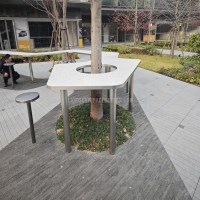
An outdoor bar counter with stainless steel and terrazzo materials in an irregular shape






