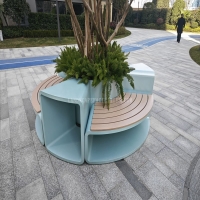
Welcome to the website for landscape facilities products and knowledge.

How does the table’s design accommodate the needs of high-traffic or public spaces?
In bustling environments like airports, cafes, libraries, and corporate lobbies, furniture is subjected to relentless use. The design of tables in these spaces transcends aesthetics, focusing on a core principle: engineered resilience. Accommodating high traffic requires a multifaceted approach that prioritizes durability, safety, low maintenance, and user comfort.
First, material selection is paramount. Surfaces are no longer just wood or laminate. High-pressure laminates (HPL), solid surfacing materials, porcelain, and powder-coated metals offer exceptional resistance to scratches, stains, heat, and impact. These materials ensure the table retains its appearance despite constant use and frequent cleaning with industrial chemicals.
Structural integrity is equally critical. Tables for public spaces often feature robust, reinforced leg assemblies, sometimes anchored directly to the floor to prevent tipping or shifting. Undercarriages are designed to withstand lateral forces, such as people leaning or pushing against them. The joinery between components is reinforced, moving beyond simple screws to include welding, heavy-duty brackets, and bolt-through fastenings for maximum stability.
Safety and accessibility are non-negotiable design drivers. Edges are typically rounded or softened to prevent injury. Designs comply with accessibility standards, providing adequate knee clearance and ensuring they are usable for all. Furthermore, designs often eliminate hidden corners or complex bases where debris can accumulate, simplifying cleaning.
Maintenance dictates form. The most successful designs are simple, with seamless surfaces and minimal seams where dirt can hide. Removable components for easy repair or replacement are a key feature, minimizing downtime. The choice of materials and finishes is made with easy, rapid cleaning in mind, supporting the hygiene demands of public areas.
Finally, smart design addresses ergonomics and space optimization. Tables may be lightweight for staff to reconfigure yet incredibly sturdy when in place. Modular designs that can be clustered or lined up provide flexibility. Shapes are chosen to facilitate traffic flow—round tables in tight spaces, long communal tables for efficient seating. The ultimate goal is to create a piece that endures physically while supporting the social and functional rhythms of public life.
Related search: