Welcome to the website for landscape facilities products and knowledge.

How does the table’s design accommodate the growing trend of hot-desking or shared workspaces?
The modern workplace is undergoing a fundamental shift, moving away from assigned cubicles toward dynamic, flexible environments like hot-desking and shared workspaces. This evolution demands a parallel transformation in office furniture, particularly table design. No longer static monuments to individual occupancy, tables must now be agile, intelligent, and communal facilitators of productivity.
At the core of this adaptation is modularity. Tables designed with interchangeable components, reconfigurable shapes, and easy-to-move lightweight structures are essential. Benching systems that can be easily expanded or contracted, and modular units that form clusters for team projects or separate into focused work pods, directly accommodate the fluctuating daily occupancy of shared spaces. This inherent flexibility allows the workspace itself to morph according to immediate needs.
Technology integration is another critical pillar. The transient nature of hot-desking necessitates seamless connectivity. Tables now routinely feature built-in, universal power outlets, wireless charging pads, and centralized cable management troughs that keep cords accessible yet untangled. This "plug-and-play" infrastructure allows any employee to claim any spot and be instantly operational, eliminating the hunt for power sources and reducing desk clutter—a common pain point in shared environments.
Furthermore, ergonomic design becomes a shared responsibility. With multiple users of different statures and preferences using the same station daily, tables with easy-to-operate, electric height-adjustable mechanisms are paramount. They promote employee well-being by allowing personalized, healthy postures throughout the day, which is crucial when people cannot customize a permanent desk. Durability and easy-to-clean surfaces also become non-negotiable features, ensuring longevity and hygiene in high-turnover settings.
The design philosophy itself shifts from ownership to experience. Tables for shared spaces often incorporate elements that foster incidental collaboration, such as rounded edges, integrated whiteboards, or subtle dividers that offer acoustic privacy without visual isolation. Storage solutions transform into compact, mobile pedestals or centralized lockers, freeing the tabletop as a clean, communal work surface.
In essence, the table in a hot-desking ecosystem is no longer just a piece of furniture; it is a responsive platform. Its success is measured by its ability to empower mobility, foster both collaboration and concentration, and seamlessly integrate technology—all while supporting the physical well-being of a diverse, rotating user base. By prioritizing flexibility, connectivity, and ergonomic intelligence, contemporary table design doesn't just accommodate the trend of shared workspaces; it actively enables and enhances their very purpose.
Related search:
Recommendation
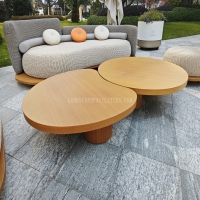
Elliptical metal outdoor table with nested design, resembling wood grain, round table






