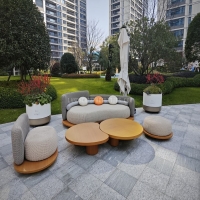
Welcome to the website for landscape facilities products and knowledge.

What are the most important design considerations for ensuring the Landscape Round Table’s longevity?
What defines a Landscape Round Table's ability to withstand decades of outdoor use? The answer lies in a holistic design philosophy that prioritizes material integrity, intelligent construction, and environmental harmony. First, material selection is paramount. High-density hardwoods like teak or ipe, naturally rot-resistant, or powder-coated aluminum with a Class 3 coating rating, provide inherent durability against moisture, UV rays, and temperature fluctuations. The construction methodology must complement this. Mortise-and-tenon joinery, stainless steel fasteners, and allowance for wood's natural expansion/contraction prevent structural failure. A critical, often overlooked, consideration is water management. Table surfaces should feature a slight pitch or integrated drainage channels, while leg designs must avoid water traps. Furthermore, the base must be engineered for ground stability, using adjustable footings or broad pedestals to prevent sinking or wobbling on uneven terrain. Finally, a design that facilitates easy maintenance—such as accessible surfaces for resealing or replaceable component parts—significantly extends service life. Ultimately, longevity is not an add-on feature but the result of every design decision, from the molecular structure of the materials to the macro placement in the landscape, working in concert to defy time and the elements.
Related search: