Welcome to the website for landscape facilities products and knowledge.

What are the most effective ways to reduce the environmental impact of the Landscape Round Table’s lifecycle?
The environmental impact of a product, such as a Landscape Round Table, extends far beyond its use in a garden or park. Its true footprint is woven through every stage of its existence. To genuinely reduce this impact, a holistic, lifecycle-oriented approach is essential, moving from linear "take-make-dispose" models to circular thinking.
The most effective mitigation begins at the drawing board with Eco-Design and Material Innovation. Prioritizing rapidly renewable, recycled, or certified sustainable materials (like FSC-certified wood, recycled aluminum, or post-consumer plastic) drastically cuts initial resource depletion. Designing for durability, modularity, and easy repair extends the product's functional life, while avoiding toxic finishes protects ecosystems during use and at disposal.
Optimizing Manufacturing and Logistics forms the next critical pillar. Sourcing materials locally and manufacturing near key markets slashes transportation emissions. Factories powered by renewable energy and employing closed-loop water systems minimize operational footprints. Efficient packaging design, using recycled and recyclable materials, further reduces waste before the table even reaches the customer.
The Use Phase offers significant, often overlooked, opportunities. Providing customers with clear care and maintenance guides ensures longevity. For commercial settings, implementing lease or service models where the manufacturer retains ownership incentivizes designing for longevity, easy refurbishment, and ultimate recovery of materials. This shifts the economic model from selling volume to providing enduring service.
Finally, planning for End-of-Life and Circularity is paramount. Designing for disassembly allows components to be easily separated, repaired, reused, or recycled. Establishing take-back programs ensures tables are responsibly decommissioned, with materials fed back into new production cycles. Biodegradable options for certain components can be considered, but only within controlled systems to avoid pollution.
Ultimately, the most effective way to reduce a Landscape Round Table's environmental impact is to reimagine it not as a product with an end, but as a temporary repository of valuable materials in a continuous loop. By embedding circular economy principles—designing out waste, keeping materials in use, and regenerating natural systems—we can create outdoor furniture that enhances landscapes without degrading the planet.
Related search:
Recommendation
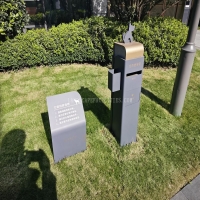
Outdoor cat and dog feces trash can; Community pet trash can; Metal multi-color design






