Welcome to the website for landscape facilities products and knowledge.

How does the table’s design enhance its use in environments requiring quick and easy reconfiguration?
In today's fast-paced work and event environments, the design of tables plays a pivotal role in enabling quick and effortless reconfiguration. Modern tables achieve this through several key design principles that prioritize adaptability without compromising stability or aesthetics.
Firstly, modularity stands as the cornerstone of reconfigurable table design. Many contemporary systems utilize interlocking panels or standardized connectors that allow multiple tables to combine into larger surfaces or separate into individual units within minutes. This modular approach eliminates the need for complex tools or specialized labor, empowering users to transform spaces according to immediate needs.
Secondly, lightweight yet durable materials such as aircraft-grade aluminum composites or reinforced polymers facilitate easy movement. These materials provide structural integrity while reducing overall weight, enabling a single person to reposition tables quickly. Integrated handles or ergonomic edge designs further enhance portability, making rearrangement an intuitive process rather than a physical burden.
Thirdly, innovative leg and frame mechanisms contribute significantly to reconfiguration speed. Features like foldable legs with automatic locking systems, wheeled bases with central braking, or height-adjustable telescopic legs allow tables to be adapted for different functions—from standing meetings to seated workshops—without requiring replacement or additional equipment. Some designs incorporate nesting capabilities, where tables stack compactly when not in use, freeing floor space for other activities.
Furthermore, surface design elements support flexible use. Tables with reversible tops (one side writable, the other decorative) or built-in cable management channels can serve multiple purposes instantly. This duality reduces the need to switch furniture between presentation modes, collaborative sessions, or individual work setups.
The psychological impact of such design should not be underestimated. Tables that are visibly easy to reconfigure encourage teams to experiment with spatial arrangements, fostering collaboration and creativity. In educational settings, quick-reconfiguration tables allow teachers to shift between lecture formats and group activities seamlessly, maintaining instructional momentum.
Ultimately, thoughtful table design transforms physical spaces from static layouts into dynamic ecosystems. By integrating modular components, intuitive mobility features, and multifunctional surfaces, these tables respond to the evolving demands of modern environments—where speed, flexibility, and user autonomy are paramount. The result is not merely furniture, but a tool for spatial innovation that enhances productivity, interaction, and resource efficiency in any setting requiring frequent transformation.
Related search:
Recommendation
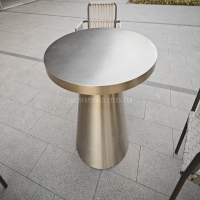
Outdoor Metal Table - Classic Outdoor Furniture, Stainless Steel Table, Durable and Reliable






