Welcome to the website for landscape facilities products and knowledge.

How does the table’s design impact the acoustics of the room it’s placed in?
The often-overlooked table is a silent conductor in the acoustic orchestra of a room. Its design profoundly influences sound quality, affecting everything from conversation clarity to audio playback. The primary mechanisms are reflection, absorption, and diffusion.
Material is the foremost factor. Hard, dense surfaces like polished stone, glass, or lacquered wood act as efficient sound mirrors. They reflect high-frequency sounds (speech, clinks), which can increase liveliness but also cause harsh echoes, flutter, and comb filtering—a phenomenon where direct and reflected sound waves interfere, creating peaks and dips in frequency. Conversely, porous materials like thick, unfinished wood, felt, or fabric-covered tables absorb sound energy, particularly high frequencies, reducing reverberation and creating a drier, more dampened acoustic environment.
Shape dictates the reflection's direction. A large, flat rectangular table acts like an acoustic wall, creating strong, specular reflections that can be directed to specific spots. A circular or oval table, however, scatters sound waves more diffusely, breaking up coherent reflections and promoting a more even, blended sound field. The table's edge profile also matters; sharp edges tend to reflect sound in a more focused beam, while rounded edges encourage diffusion.
Size and placement are critical. A large conference table in the center of a room creates a significant reflective plane between speakers, potentially causing distracting early reflections. Its presence also affects low-frequency modes by altering the room's effective volume and symmetry. Placing a table against a wall doubles its reflective impact, as sound bounces from the table to the wall and back into the room.
Ultimately, a table's acoustic role is defined by its context. In a dead home theater, a reflective table might add needed acoustic energy. In a reverberant cafeteria, an absorptive one would improve intelligibility. Understanding these principles allows for intentional design, turning a mere piece of furniture into a tool for sculpting the sonic character of a space.
Related search:
Recommendation
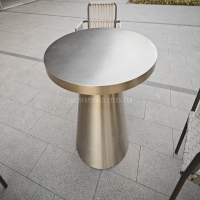
Outdoor Metal Table - Classic Outdoor Furniture, Stainless Steel Table, Durable and Reliable






