Welcome to the website for landscape facilities products and knowledge.

How does the table’s design account for the prevention of glare or reflections in bright lighting?
In environments with intense illumination, table design plays a crucial role in visual comfort and productivity. Manufacturers employ several strategic approaches to mitigate disruptive glare and reflections. The primary defense is the use of matte finishes, which diffuse light rather than reflecting it directly. These non-gloss surfaces scatter incoming light rays, eliminating harsh specular reflections that cause eye strain.
Textured materials provide another effective solution. Surfaces with micro-textures or slight irregularities break up light patterns, preventing the formation of coherent reflective images. This approach maintains functionality while ensuring visual clarity. Material selection further enhances this effect, with engineered woods, laminates, and certain composites offering inherently low-reflectance properties.
Advanced tables incorporate light-absorbing pigments or coatings that reduce surface reflectivity without compromising durability. The strategic angling of table surfaces also contributes significantly; many designs feature slight negative tilts or non-parallel alignment with common light sources to redirect reflections away from the user's sightline.
Edge treatments and rounded corners minimize peripheral glare points, while integrated matte protective coatings on glass tables provide transparency without high reflectivity. These design considerations collectively create workspaces that remain functional and comfortable even under bright lighting conditions, supporting prolonged focus and reducing visual fatigue. The evolution of these features represents a thoughtful intersection of ergonomic science and material innovation in modern furniture design.
Related search:
Recommendation
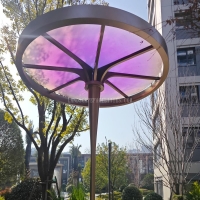
Metal frame with gradient color acrylic combined with high-end shading landscape facilities






