Welcome to the website for landscape facilities products and knowledge.

What are the options for integrating the table with smart technology or IoT devices?
The traditional table is undergoing a revolutionary transformation, evolving from a passive piece of furniture into an active hub for connectivity and convenience. Integrating tables with smart technology and the Internet of Things (IoT) opens a realm of possibilities for both residential and commercial spaces. The primary options for this integration focus on enhancing functionality, user experience, and environmental interaction.
One of the most popular integrations is the inclusion of wireless charging surfaces. By embedding Qi or similar charging standards into the tabletop, users can simply place compatible smartphones, earbuds, or tablets on designated zones to power up, eliminating cable clutter. This can be extended to multi-device charging pads or even entire conductive surfaces.
Embedded sensors and environmental controls represent a sophisticated option. Tables can be equipped with sensors to monitor room conditions like temperature, humidity, and air quality, displaying data on a built-in touchscreen or LED matrix. Some advanced models can link this data to smart HVAC systems for automated climate adjustment. Pressure sensors can also be used for interactive applications or to detect occupancy.
Voice control and smart assistant integration turn a table into a command center. With built-in microphones and speakers connected to platforms like Amazon Alexa, Google Assistant, or Apple HomeKit, users can control connected lights, play music, set reminders, or manage other smart devices through simple voice commands issued near the table.
For connectivity, tables can incorporate USB-C hubs, Bluetooth beacons, or even Wi-Fi extenders. This transforms them into a central docking station for laptops and peripherals or a node that strengthens the home network. In office settings, smart tables can facilitate seamless presentation sharing and video conferencing through integrated systems.
Finally, aesthetic and ambient integrations include LED lighting systems that can change color based on mood, time of day, or notifications from other devices. These lights can sync with entertainment systems for immersive movie nights or be programmed for productivity-focused lighting.
The key to successful integration lies in a modular approach, allowing users to add or upgrade features, and a focus on seamless design where technology enhances rather than dominates the furniture's form and primary function. The future points towards tables that not only hold our objects but also intelligently interact with them and us.
Related search:
Recommendation
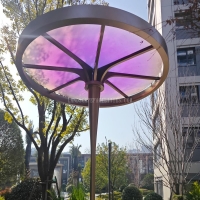
Metal frame with gradient color acrylic combined with high-end shading landscape facilities






