Welcome to the website for landscape facilities products and knowledge.

How does the table’s design account for varying levels of user weight distribution?
Modern table design incorporates sophisticated engineering principles to accommodate diverse user weight distributions. The fundamental approach involves calculating maximum load capacity while considering uneven weight application scenarios. Engineers utilize stress analysis software to simulate various weight distribution patterns, from concentrated center loads to asymmetrical edge pressures. This predictive modeling informs critical design decisions regarding material thickness, support structure placement, and joint reinforcement.
The table's structural integrity primarily depends on its leg configuration and bracing system. Four-legged designs typically employ cross-bracing to redistribute weight, while pedestal tables utilize radial support structures that channel weight downward evenly. Material selection plays a crucial role - solid wood offers natural load distribution properties, while engineered materials like MDF require additional internal reinforcement to prevent sagging under concentrated weight.
Advanced manufacturing techniques enable the creation of tabletops with varying density cores, where higher density materials are strategically placed in areas prone to heavier use. The integration of apron designs and additional center supports further enhances weight distribution capabilities. For commercial applications, tables often incorporate redundant support systems that create multiple load paths, ensuring stability even when subjected to imbalanced weight scenarios.
Quality testing involves subjecting prototypes to standardized weight distribution tests that simulate real-world usage patterns exceeding normal expectations. This includes cyclic loading tests that evaluate long-term structural performance under repeated stress. The resulting designs achieve optimal balance between aesthetic appeal and functional reliability, safely accommodating the dynamic nature of how people actually use tables in various environments.
Related search:
Recommendation
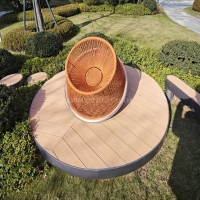
Swivel chair-Specialty steel structure woven rattan leisure chair with rotatable design






