Welcome to the website for landscape facilities products and knowledge.

How does the table’s design address concerns about interference with wildlife habitats?
When considering outdoor furniture, particularly tables designed for natural settings, manufacturers have developed innovative approaches to minimize disruption to local ecosystems. Modern wildlife-conscious table design incorporates several key principles that address habitat protection directly.
The most significant innovation lies in elevated construction techniques. Rather than using traditional four-leg ground contact that disturbs soil composition and microhabitats, many contemporary designs employ suspended or cantilevered mechanisms. These structures minimize ground disturbance while providing stable surfaces for human use. The reduced footprint means less compaction of important soil areas where insects, fungi, and small mammals thrive.
Material selection plays an equally crucial role in habitat preservation. Designers increasingly utilize sustainably sourced wood with Forest Stewardship Council certification, ensuring responsible forestry practices. Alternatively, composite materials made from recycled plastics avoid deforestation entirely while providing durable surfaces resistant to weathering. These conscious material choices prevent habitat destruction at both sourcing and installation phases.
The integration approach represents another thoughtful dimension. Instead of clearing areas for table placement, designs now often incorporate existing landscape features. Tables might wrap around mature trees rather than requiring their removal, or utilize natural rock formations as foundational supports. This preservation of existing habitat elements maintains crucial wildlife corridors and feeding grounds.
Installation methods have evolved to become minimally invasive. Ground screw foundations replace concrete pouring, eliminating soil contamination and allowing for future removal without permanent damage. This technique preserves root systems and burrowing animal habitats that traditional concrete footings would destroy indefinitely.
Designers also consider seasonal wildlife patterns. Some tables feature removable sections during nesting seasons, while others incorporate natural camouflage coloring that blends with surroundings rather than creating visual disturbances. The height and positioning often account for animal movement paths, ensuring tables don't block established wildlife corridors.
Beyond physical structure, the very concept of outdoor tables has expanded to include habitat enhancement features. Some designs incorporate native planters within their bases, supporting local vegetation crucial for pollinators. Others include small integrated water collection systems that provide drinking sources for animals during dry periods.
Through these multifaceted approaches—elevated construction, sustainable materials, integrated placement, and non-invasive installation—modern table design demonstrates that human comfort and wildlife preservation can coexist harmoniously. The evolution of outdoor furniture reflects our growing understanding that every element we introduce to natural spaces should serve both human needs and ecological responsibility.
Related search:
Recommendation
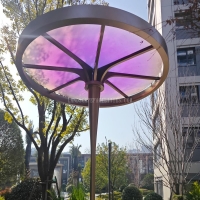
Metal frame with gradient color acrylic combined with high-end shading landscape facilities






