Welcome to the website for landscape facilities products and knowledge.

How do manufacturers address the challenge of maintaining consistent color in dyed wicker materials?
Maintaining consistent color in dyed wicker materials is a critical challenge for manufacturers, as variations can affect product quality and customer satisfaction. To address this, manufacturers employ several strategies:
1. High-Quality Dyes and Pigments: Using premium, UV-resistant dyes ensures long-lasting color vibrancy and reduces fading over time. Manufacturers often opt for dyes specifically formulated for natural fibers like rattan, bamboo, or synthetic wicker.
2. Pre-Treatment Processes: Wicker materials are pre-treated to remove impurities and ensure even dye absorption. This step is crucial for achieving uniform color distribution across batches.
3. Controlled Dyeing Conditions: Temperature, pH levels, and dyeing duration are meticulously monitored during production. Automated systems help maintain consistency, minimizing human error.
4. Post-Dyeing Treatments: Sealants or protective coatings are applied to lock in color and enhance durability. These treatments also guard against moisture, sunlight, and wear.
5. Rigorous Quality Control: Samples from each batch are tested for color accuracy under different lighting conditions. Advanced spectrophotometers measure color deviations, ensuring compliance with industry standards.
6. Sustainable Practices: Eco-friendly dyeing methods, such as water-saving techniques or plant-based dyes, are increasingly adopted to meet environmental regulations without compromising color consistency.
By integrating these approaches, manufacturers deliver dyed wicker products with reliable, fade-resistant colors, meeting both aesthetic and functional demands.
Related search:
Recommendation
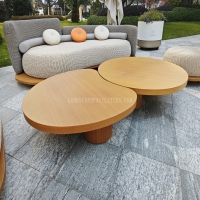
Elliptical metal outdoor table with nested design, resembling wood grain, round table






