Welcome to the website for landscape facilities products and knowledge.

How does the slope or gradient of the installation site impact the design and construction of a landscape bar counter?
The slope or gradient of an installation site fundamentally transforms the approach to designing and building a landscape bar counter. Unlike a level site, a sloped terrain introduces unique challenges and opportunities that demand careful consideration from the initial concept to the final construction phase.
A primary concern is structural integrity and foundation. A significant slope requires extensive earthwork, such as cutting into the hill or building up the lower section to create a stable, level platform. This often involves constructing robust retaining walls to prevent soil erosion and provide crucial support for the bar's weight. The foundation itself must be engineered to distribute loads unevenly due to the gradient, potentially requiring deep piers or specialized footings to ensure long-term stability and safety, preventing any shifting or sinking.
The gradient also dictates the bar's functional design and ergonomics. On a steep slope, a multi-level or terraced design is often the most effective solution. This allows the bar counter to follow the natural contour of the land, creating distinct zones for preparation, serving, and seating. The height of the bar counter must be calibrated precisely from all sides to ensure it is at a comfortable and usable height for both standing and seated guests, despite the changing ground level beneath it.
Furthermore, the slope impacts drainage and water management, a critical factor for any outdoor structure. Designers must incorporate solutions to channel rainwater away from the bar's foundation to prevent erosion, pooling, or water damage. This can involve integrating subtle slopes into the countertop itself, installing French drains, or using permeable materials in the surrounding hardscape to manage runoff effectively.
Material selection is equally influenced by the terrain. Building on a slope can complicate the delivery and installation of heavy materials like stone or concrete. Lighter, modular materials or those that can be assembled on-site might be preferred. The choice of materials must also account for their slip resistance, especially for flooring around the bar, to ensure safety on an inclined surface.
Ultimately, a sloped site should be viewed not as a obstacle but as a design asset. A well-executed landscape bar on a gradient can offer breathtaking panoramic views, create dynamic, intimate spaces, and achieve a truly organic integration with its natural surroundings. The key to success lies in a meticulous site analysis, innovative design that works with the landform, and precise construction techniques that guarantee both beauty and resilience.
Related search:
Recommendation
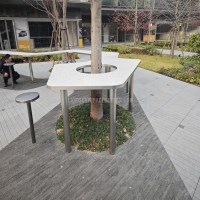
An outdoor bar counter with stainless steel and terrazzo materials in an irregular shape






