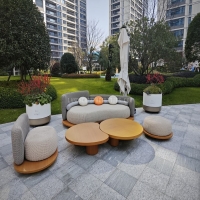
Welcome to the website for landscape facilities products and knowledge.

How does the choice of material impact the overall resistance to warping from humidity?
The relationship between material composition and susceptibility to moisture-induced warping represents a critical consideration in manufacturing and construction. Materials respond differently to humidity fluctuations based on their inherent physical properties and structural characteristics.
Wood remains particularly vulnerable to dimensional changes due to its hygroscopic nature. As relative humidity increases, wood fibers absorb atmospheric moisture, expanding disproportionately across different grain directions. This anisotropic swelling creates internal stresses that manifest as warping, cupping, or twisting. Hardwoods with tighter grain patterns typically demonstrate superior dimensional stability compared to softwoods.
Engineered wood products address these limitations through cross-laminated construction. Plywood and oriented strand board (OSB) feature alternating grain directions that counteract swelling forces, significantly reducing their tendency to warp despite moisture exposure. The adhesive resins used in these composites further mitigate moisture absorption.
Plastics present a diverse range of behaviors. Nylon and other polyamides absorb considerable moisture, leading to noticeable dimensional changes. In contrast, polypropylene, polyethylene, and PVC exhibit minimal moisture absorption, maintaining their dimensional stability even in high-humidity environments. Fiber-reinforced composites combine polymer matrices with glass or carbon fibers to create materials with exceptionally low coefficients of moisture expansion.
Metals generally resist moisture absorption but remain susceptible to corrosion-induced distortion in humid environments. Aluminum forms a protective oxide layer that prevents further degradation, while stainless steel's chromium content provides exceptional resistance to both corrosion and dimensional changes.
Advanced composite materials demonstrate particularly interesting behavior. Carbon fiber reinforced polymers (CFRP) and glass fiber reinforced polymers (GFRP) combine low moisture absorption with high dimensional stability, making them ideal for applications where precision must be maintained despite humidity fluctuations.
The material's thermal expansion coefficient interacts with its moisture expansion properties, creating complex responses to environmental changes. Materials with closely matched thermal and hygroscopic expansion rates tend to maintain greater overall dimensional stability.
Material selection must consider the specific environmental conditions and precision requirements of each application. Understanding the fundamental relationship between material structure, moisture absorption, and dimensional stability enables engineers and designers to select materials that will maintain their integrity and performance despite fluctuating humidity conditions.
Related search: