Welcome to the website for landscape facilities products and knowledge.

What are the key differences between round, square, and rectangular landscape tables in terms of usability?
When selecting landscape tables for outdoor spaces, the shape plays a crucial role in usability, space efficiency, and social dynamics. Here’s a breakdown of the key differences between round, square, and rectangular tables:
Round Tables:
- Usability: Ideal for fostering conversation, as everyone faces the center equally. No "head" position makes them great for casual gatherings.
- Space Efficiency: Requires less clearance due to no sharp corners, fitting well in compact or curved areas.
- Drawbacks: Limited seating capacity compared to rectangular tables of similar size.
Square Tables:
- Usability: Best for small groups (4-6 people) and creates an intimate setting. Works well in modular or symmetrical layouts.
- Space Efficiency: Fits neatly in square or grid-like spaces but may waste space in larger, open areas.
- Drawbacks: Can feel rigid for larger groups, as distant corners hinder conversation.
Rectangular Tables:
- Usability: Maximizes seating capacity, making them perfect for large gatherings or dining. Creates a formal "head of the table" dynamic.
- Space Efficiency: Fits well along walls or in linear spaces but requires more room for circulation.
- Drawbacks: Less conducive to group-wide interaction; end seats may feel isolated.
Final Considerations:
- Social Interaction: Round > Square > Rectangular (for inclusivity).
- Seating Capacity: Rectangular > Square > Round.
- Space Adaptability: Round > Square > Rectangular.
Choose based on your priorities—whether it’s fostering conversation, maximizing seating, or optimizing space. Each shape brings unique advantages to outdoor living areas.
Related search:
Recommendation
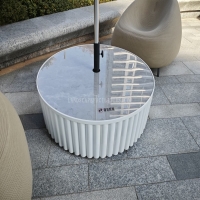
Round metal tube border design table with tempered glass or granite countertop on the top.






