Welcome to the website for landscape facilities products and knowledge.

What is the table’s resistance to bending under heavy loads over time?
The question of a table's long-term resistance to bending under heavy loads delves into the core principles of structural integrity and material science. It is not merely about immediate strength but about creep resistance – the material's ability to withstand a constant, heavy force without gradually deforming over time.
Several critical factors determine this performance. Material selection is paramount. Solid hardwoods (like oak or maple), high-quality engineered woods with robust cores, and metals (steel, aluminum) offer superior long-term resistance compared to particleboard or low-density woods. The structural design is equally crucial. Features such as substantial apron beams, strategic leg bracing, center supports, and increased thickness of the tabletop directly combat bending moments. The construction quality, including the type of joints (e.g., mortise and tenon, dowels) and the adequacy of fasteners, ensures the design's potential is fully realized.
Over time, a poorly resistant table will exhibit sagging or deflection in the center, especially over long spans. This is a failure of the table's load-bearing capacity and long-term stability. Regular overloading accelerates this fatigue, compromising the furniture's durability.
Therefore, a table's bending resistance is a function of its material strength, intelligent engineering design, and precise construction. For guaranteed long-term performance under heavy, sustained loads, prioritize tables built with these principles from high-specification materials, ensuring they remain stable, flat, and reliable for years to come.
Related search:
Recommendation
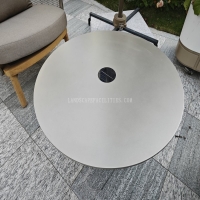
Outdoor stainless steel table with solar-powered ambient lighting feature - excellent design.






