Welcome to the website for landscape facilities products and knowledge.

How does the table’s surface handle exposure to outdoor lighting rigs?
Professional outdoor events frequently utilize powerful lighting rigs, raising valid concerns about table surface durability. High-quality commercial outdoor tables are engineered to handle this exposure through multiple protective mechanisms.
The primary challenge is ultraviolet (UV) radiation from prolonged exposure to bright lights. Premium tables incorporate UV-inhibited materials or finishes that prevent fading, chalking, and molecular degradation. Polyethylene, powder-coated aluminum, and certain treated woods effectively block harmful UV wavelengths.
Heat resistance is equally critical. Lighting rigs, especially halogen or incandescent fixtures, emit significant infrared radiation. Suitable table surfaces feature heat-stable materials that resist warping, softening, or discoloration. Tempered glass tops, certain composites, and metals are ideal as they dissipate heat efficiently without sustaining damage.
Material selection dictates performance. Powder-coated aluminum offers excellent all-weather and light-resistant qualities. High-density polyethylene (HDPE) is inherently UV-stable and moisture-proof. Teak and other dense hardwoods, when properly oiled, provide natural resilience. Manufacturers often accelerate testing in controlled chambers simulating years of intense light and weather exposure.
For venue managers, key specifications include the material's UV rating, maximum continuous service temperature, and ingress protection (IP) rating for moisture. Regular maintenance—cleaning with pH-neutral solutions and inspecting for microfractures—prolongs lifespan even under intense lighting conditions.
Ultimately, investing in tables specifically rated for commercial outdoor use ensures they withstand not just weather, but the rigorous demands of professional event production, maintaining aesthetics and structural integrity over time.
Related search:
Recommendation
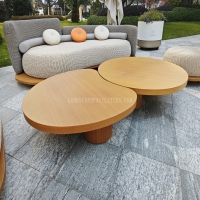
Elliptical metal outdoor table with nested design, resembling wood grain, round table






