Welcome to the website for landscape facilities products and knowledge.

How does the table’s design account for privacy in semi-public outdoor spaces?
In the evolving landscape of urban design, semi-public outdoor spaces—such as café patios, park plazas, and corporate courtyards—present a unique challenge: fostering social engagement while respecting individual privacy. The design of outdoor tables plays a pivotal, often overlooked role in addressing this duality. Modern solutions move beyond mere aesthetics to incorporate nuanced privacy-by-design principles.
Strategically, tables are often positioned to create natural territorial boundaries. Angled placements or clusters, rather than rigid grid formations, discourage unwanted visual intrusion and define semi-private zones for small groups. The physical design of the table itself is crucial. Tables with integrated, modestly-sized vertical elements—such as low planters, subtle frosted glass dividers, or textured side panels—act as visual buffers without creating oppressive barriers. These elements disrupt sightlines from a distance while allowing face-to-face conversation for seated users.
Material selection further enhances acoustic and psychological privacy. Tables constructed with sound-absorbing materials like textured concrete, perforated metal, or thick, solid wood can dampen ambient noise and conversation bleed, creating a more intimate auditory bubble. The scale and proportion are equally considered; a table surface that is adequately wide prevents occupants from feeling cramped, yet its dimensions are carefully calibrated to discourage the joining of unrelated parties, thus maintaining group integrity.
Furthermore, the integration of biophilic design, such as built-in central planters, leverages natural elements to organically segment space. This provides a soft, green screen that enhances the sense of seclusion. Lighting integrated into the table structure can also define territory during evening hours, gently illuminating the immediate user area while leaving surrounding spaces dimmer, which psychologically reinforces the private enclave.
Ultimately, effective table design in these settings employs a holistic approach. It considers sightlines, acoustics, ergonomics, and human behavior to create micro-territories. The goal is not isolation but managed exposure—offering users the choice to participate in the public realm while providing a comforting layer of control and seclusion. This thoughtful design accounting for privacy transforms semi-public spaces into more inviting, versatile, and user-centric environments, encouraging longer stays and positive social experiences.
Related search:
Recommendation
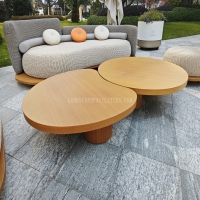
Elliptical metal outdoor table with nested design, resembling wood grain, round table






