Welcome to the website for landscape facilities products and knowledge.

How does the table’s design account for ease of integration with outdoor exhibition booths?
Modern outdoor exhibition table design strategically addresses integration challenges through several innovative approaches. Manufacturers prioritize modular construction, allowing tables to interconnect with booth walls, canopies, and display units using universal connector systems. This modularity enables exhibitors to create cohesive, customized layouts without specialized tools or technical expertise.
The integration process begins with standardized dimensions that align with common booth footprints and panel systems. Tables feature precise edge profiles that seamlessly abut against booth structures, eliminating awkward gaps where promotional materials could get damaged or create tripping hazards. Many designs incorporate built-in cable management channels that align with booth electrical access points, safely concealing power cords and data cables while maintaining accessibility.
Transport integration is equally crucial. Tables designed for outdoor exhibitions often feature nesting, stacking, or folding mechanisms that match the storage dimensions of standard booth transportation cases. This coordinated sizing minimizes packaging waste and simplifies logistics. Some advanced models include integrated wheel bases that match the height of loading docks and common freight carts, enabling smooth transitions between storage, transport, and display positions.
Material selection further supports integration. Powder-coated aluminum frames often match the finish of booth structural components, creating visual continuity. Tabletops with edge banding that complements booth graphics create a unified aesthetic. The use of UV-resistant laminates and waterproof substrates ensures tables maintain their integrated appearance throughout multi-day events despite sun exposure or humidity fluctuations.
Perhaps most innovatively, contemporary designs incorporate adaptive leveling systems. These adjustable feet compensate for uneven outdoor surfaces—a common challenge at temporary exhibition venues—ensuring tables integrate perfectly with booth structures regardless of ground conditions. This attention to environmental adaptability distinguishes truly integrated outdoor exhibition furniture from merely portable indoor tables used outside.
Ultimately, successful integration stems from designing tables as interconnected components within larger display ecosystems rather than standalone pieces. This systems-thinking approach results in furniture that enhances booth stability, expands functional space, and projects professional cohesion—all critical factors for outdoor exhibition success where environmental elements constantly test every component's compatibility and resilience.
Related search:
Recommendation
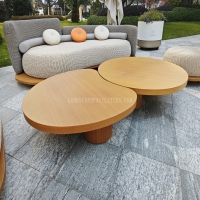
Elliptical metal outdoor table with nested design, resembling wood grain, round table






