Welcome to the website for landscape facilities products and knowledge.

How does the table’s design minimize the risk of pinching or trapping fingers?
A well-designed table prioritizes user safety, particularly in minimizing the risk of pinching or trapping fingers. This is achieved through several key engineering and design principles. First, the implementation of rounded, softened edges on table tops and legs eliminates sharp corners where fingers could get caught. Second, for tables with extending leaves or adjustable height mechanisms, designers incorporate smooth-gliding systems with covered tracks or gaps. These systems often use slow-close mechanisms and physical barriers that block access to moving joints. Third, the stability of the table is crucial; a sturdy base prevents accidental tipping that could lead to finger injuries. Furthermore, the choice of materials plays a role—durable, splinter-free surfaces with consistent finishes prevent unexpected snags. Ultimately, the integration of these features—from macroscopic geometry to microscopic finish—creates a cohesive safety profile. This thoughtful design approach is especially vital in environments with children or high traffic, ensuring the furniture is both functional and inherently protective without requiring constant user vigilance. The goal is passive safety: protection built into the form, not added as an afterthought.
Related search:
Recommendation
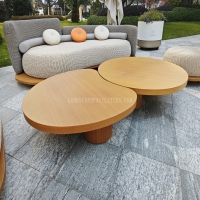
Elliptical metal outdoor table with nested design, resembling wood grain, round table






