Welcome to the website for landscape facilities products and knowledge.

What is the table’s performance in terms of sound absorption or reflection?
When evaluating a table's acoustic performance, its behavior in sound absorption or reflection is primarily determined by material composition, surface design, and structural density. Hard, non-porous materials like polished stone, glass, or dense laminate primarily reflect sound waves, often increasing ambient noise levels and reverberation in a space. Conversely, tables constructed from porous materials like unfinished solid wood, felt-covered composites, or perforated acoustic panels absorb sound energy, reducing echo and background noise.
The table's role in room acoustics is frequently underestimated. A large reflective conference table can exacerbate speech intelligibility issues, while an absorptive dining table in a restaurant can dampen clatter and improve comfort. Key factors include surface texture—a rough, textured wood absorbs more than a high-gloss finish—and internal structure. Some modern acoustic tables even incorporate specialized core materials designed for optimal noise reduction.
Performance is measurable using metrics like the Noise Reduction Coefficient (NRC). A high NRC (closer to 1.0) indicates strong absorption, while a low NRC (near 0) signifies high reflection. For optimal acoustic environments, the choice depends on function: reflective surfaces may be desired for lively social spaces, while absorptive ones are critical for focused work or clear communication zones. Ultimately, a table is not just furniture but an active component in shaping a room's sonic character.
Related search:
Recommendation
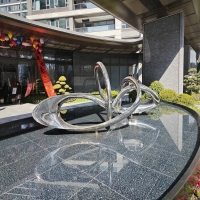
Abstract art sculpture, stainless steel metal sculpture, large-scale water feature sculpture






