Welcome to the website for landscape facilities products and knowledge.

How does the table’s weight distribution affect its stability when loaded unevenly?
A table's stability under load is fundamentally governed by the principles of physics, specifically its center of gravity and the geometry of its support base. When weight is distributed evenly, the combined center of gravity of the table and its load remains centrally located over the support base, resulting in optimal stability. However, uneven loading—such as placing a heavy object near one edge—shifts this center of gravity horizontally. If the shifted center of gravity projects outside the table's footprint (the area bounded by its legs or pedestal), a tipping moment is created. This moment, the product of the offset weight and its horizontal distance from the pivot point (typically a leg), can overcome the restoring moment provided by the table's own weight, leading to a potential tip-over.
Several factors amplify this effect. Tables with a high center of gravity (e.g., tall, narrow console tables) are inherently less stable, as the lever arm for the offset load is longer. Conversely, designs with a wide, low base of support resist tipping more effectively. The table's structural mass also plays a role; a heavier table itself provides a greater restoring moment. Furthermore, leg design is critical. Splayed legs or a central pedestal that extends to a broad foot create a larger virtual footprint, increasing the distance the center of gravity must travel before causing a tip.
To enhance stability, consider both design and usage. Designers should prioritize a low, wide support base and adequate mass. For users, the key is conscious load management: placing heavier items centrally, avoiding excessive overhang, and for critical applications, using anchoring systems or selecting tables specifically engineered for asymmetric loads. Understanding this interplay between weight distribution and geometric design is essential for ensuring safety, longevity, and functional reliability in both furniture selection and creation.
Related search:
Recommendation
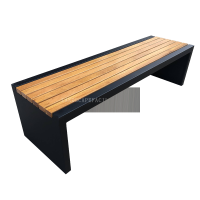
Modern Stainless Steel Begonia Wood Park Chair Outdoor Courtyard Leisure Sun Protection Bench Long Seat






