Welcome to the website for landscape facilities products and knowledge.

How does the table perform in high-traffic public spaces?
In bustling airports, vibrant cafes, and busy public plazas, furniture faces a relentless test. The performance of tables in these high-traffic environments is not a matter of chance but a result of deliberate engineering and design philosophy. Success hinges on a core principle: balancing exceptional durability with unwavering user comfort and aesthetic appeal.
The foundation is material science. High-pressure laminates (HPL), powder-coated metals, and solid surface materials are chosen for their resistance to scratches, impacts, and moisture. These surfaces repel stains, hide minor abrasions, and clean easily, maintaining their appearance through countless uses. Structural integrity is paramount. Tables are supported by robust frames, often with reinforced leg joints and cross-bracing, to prevent wobbling and withstand lateral forces from leaning or accidental bumps.
Beyond brute strength, intelligent design reduces maintenance burdens. Seamless tops eliminate dirt traps, while rounded edges enhance safety and prevent damage. For fixed installations, tables may be anchored, while freestanding models feature weighted bases for stability. The human element is also critical. Tables must accommodate diverse activities, from quick laptop work to group dining, requiring thoughtful dimensions and ergonomic heights.
Ultimately, a table's performance in a public space is measured by its longevity and its ability to fade into the background of positive user experience. It must be an unspoken, reliable piece of infrastructure—comfortable, clean, and sturdy—allowing the space's social and functional life to flourish without interruption. This seamless endurance is the hallmark of truly high-performing public furniture.
Related search:
Recommendation
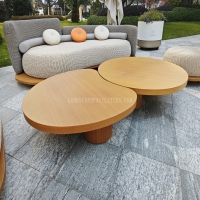
Elliptical metal outdoor table with nested design, resembling wood grain, round table






